Module 3 Learning Outcomes
- Describe the Reflective Balance Feedback Model and its evolution from the traditional Feedback Sandwich approach
- Explain how balanced, reflective feedback supports learning, accountability, and wellbeing
- Apply the Reflective Balance Model to real mediation supervision scenarios
- Demonstrate the ability to give feedback that promotes trust, growth, and reflective insight
- Reflect on the advantages and limitations of this model in supporting mediator development
Welcome to Module 3
Providing meaningful feedback is one of the most important — and delicate — skills in mediation supervision. Supervisors must support professional growth while maintaining trust, confidence, and reflective learning.
The Reflective Balance Feedback Model builds on the familiar "Feedback Sandwich" structure but evolves it into a more relational, reflective, and balanced approach. Where the sandwich model focuses on sequence (positive–constructive–positive), the Reflective Balance model focuses on balance — ensuring every feedback exchange honours three essential elements of effective supervision.
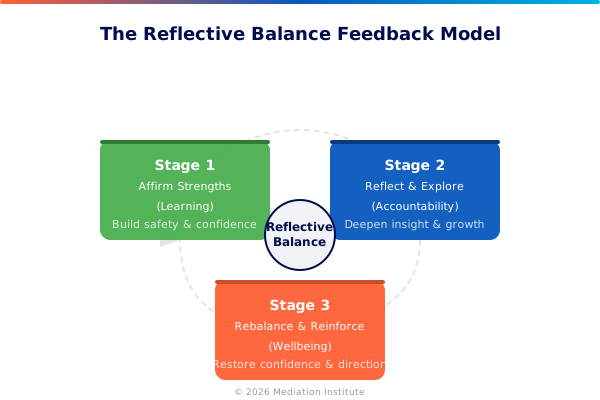
The Three Stages
Affirm Strengths (Learning) — Recognise effective practice to build openness and confidence
Reflect & Explore (Accountability) — Invite analysis of what could shift through questions over judgments
Rebalance & Reinforce (Wellbeing) — Close with encouragement, self-efficacy, and one clear next step
The Reflective Balance Feedback Model holds balance across Learning, Accountability, and Wellbeing so feedback is safe, ethical, and growth-focused. This approach aligns directly with the Tripod Model of Reflective Supervision, maintaining equilibrium between the three pillars.
By shifting from a mechanical "sandwich" to a dynamic reflective process, supervisors create a feedback environment that is safe, empowering, and genuinely transformative.
Why Feedback Matters
In supervision, feedback is not about "catching mistakes." It is a structured, reflective process that builds confidence, competence, and continuous improvement. Effective supervisors help mediators to:
- Recognise and extend strengths
- Identify growth edges in a supportive, constructive way
- Plan next steps that enhance skill, ethical clarity, and resilience
Poorly delivered feedback can trigger defensiveness and reduce learning. Thoughtful, balanced feedback promotes reflective practice and sustained professional growth. Avoid reducing the RBFM to a script; stay specific, curious, and collaborative.
From Feedback Sandwich to Reflective Balance
Many practitioners learned the Feedback Sandwich (positive → constructive → positive). It offers a simple structure but can feel formulaic. The Reflective Balance Feedback Model retains the clarity of three parts while shifting from sequence to balance and from telling to reflecting together.
| Aspect | Feedback Sandwich (Then) | Reflective Balance (Now) |
|---|---|---|
| Purpose | Soften critique with praise | Balance learning, accountability, wellbeing for genuine growth |
| Structure | Linear: positive → constructive → positive | Flexible: Affirm → Reflect → Rebalance (order adapts to need) |
| Supervisor role | Information-giver / evaluator | Reflective partner / co-inquirer |
| Supervisee role | Largely passive recipient | Active participant generating insight and action |
| Tone | Often formulaic or superficial | Relational, specific, and psychologically safe |
| Outcome | Short-term morale maintenance | Long-term capability, ethical clarity, and resilience |
When to Use the RBFM
- Routine supervision — to normalise balanced reflection
- After challenging cases — to support wellbeing while extracting learning
- Developmental reviews — to connect feedback with concrete, ethical next steps
Before you begin this module, take a moment to reflect on your own experiences with giving and receiving feedback in professional settings. What made feedback feel safe and useful? What made it feel threatening or unhelpful? Hold these reflections as you move through the pages ahead.
Your Module Pathway
| Page | Topic | Focus |
|---|---|---|
| 1 | Module Overview & the RBFM | Orientation, learning outcomes, and the model's evolution |
| 2 | Stage 1: Affirming Strengths | Theory, practical application, case study, and reflective insights |
| 3 | Stage 2: Reflective Growth | Theory, practical application, case study, and reflective insights |
| 4 | Stage 3: Rebalance & Reinforce | Theory, practical application, case study, and reflective insights |
| 5 | Integrative Application | Bringing all three stages together in practice |
| 6 | Readings & Journal | Academic references and reflective journal entry |
Relevant Frameworks and Readings
This module draws on established feedback, supervision, and reflective practice frameworks:
- Hattie & Timperley (2007) — The Power of Feedback
- Bandura (1977) — Self-Efficacy Theory
- Schön (1983) — The Reflective Practitioner
- Knowles (1984) — Adult Learning (Andragogy)
- Kolb (1984) — Experiential Learning Cycle
- Inskipp & Proctor (1993) — Functions of Supervision
- Hawkins & Shohet (2020) — Supervision in the Helping Professions
- Dweck (2006) — Growth Mindset
- Edmondson (2019) — Psychological Safety